Monday, January 30, 2017

pGLO Lab

pGLO Observations , Data Recording & Analysis
1.
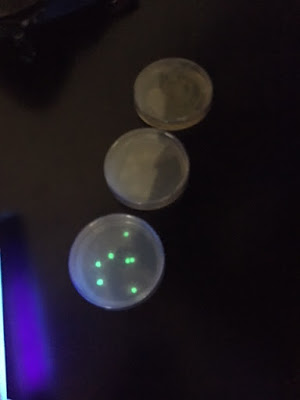
Obtain your team plates.  Observe your set of  “+pGLO” plates under room light and with UV light.  Record numbers of colonies and color of colonies. Fill in the table below.
Plate
Number of Colonies
Color of colonies under room light
Color of colonies under   UV light
- pGLO LB
0Light GrayDark Gray
- pGLO LB/amp
NoneNoneNone
+ pGLO LB/amp
6Light GrayDark Gray
+ pGLO LB/amp/ara
7WhiteGreen


2.
What two new traits do your transformed bacteria have?
The transformed bacteria now glows (because of the GFP) and is resistant to ampicilin.


3.
Estimate how many bacteria were in the 100 uL of bacteria that you spread on each plate. Explain your logic.

There are over a million bacteria in one colony. I predict that about ten colonies are in a hundred microliters (uL). Therefore, there would be about ten or eleven million bacteria in one hundred microliters.

4.
What is the role of arabinose in the plates?
The arabinose provides a way to control the expression of the glowing fluorescent protein (GFP) gene. If it is present, the GFP will cause to the bacteria to glow. If it isn't, then that won't happen.


5.
List and briefly explain three current uses for GFP (green fluorescent protein) in research or applied science.
- Fluorescence microscopy
GFP is used with fluorescence microscopes, microscopes that use fluorescence to study properties of substances. GFP has advanced and redefined this field and will cause some substances studied to fluoresce.
- Macro-photography
Certain biological processes, like the spread of virus infections, can be followed using labeling. This labeling is done with GFP. Epifluourescent camera attachments are now used instead of UV light.
- Transgenic Animals
Some animals have been genetically engineered to glow using GFP. These animals can help scientists study certain things, like human diseases, and were also marketed as pets.


6.
Give an example of another application of genetic engineering.
Bacteria can modified to make certain proteins that can obtained and used. For
example, insulin and spider silk, which are difficult to get naturally, can be made
by genetically engineered bacteria.






Thursday, January 19, 2017

Candy Electrophoresis Lab

In this lab we electrophoresed four reference dyes and four candies: red Mike and Ike's, purple Skittles, green M&Ms, and orange Reeses. The blue reference dye didn't match any of the candies' or references' length. Every dye had only one color band. Also, none of the dyes moved towards the cathode. The purple and red candy had a different dye color. The red and purple areas were also larger than those of the reference dyes. These dyes are probably just variations of the red reference dye. The dyes Citrus red 2 and Fast green FCF would migrate similarly to the dyes in this lab because they have similar structures to the reference dyes.


Dog food manufacturers may put artifical food colors in dog food to make it look more appealing to buy. Also, people will buy the food if it looks good and has color. Additionally, it could taste good for dogs. Foods I eat that would probably have artificial dyes are chips, candy (like M&Ms), macaroni and cheese, and soda (not too often). Artificial food colors can be preferable to companies rather than natural food dyes because it could be less expensive, taste better, and look appealing to eat. The length of the DNA fragment and the molecules in the dye control what distance the dye migrates. Electricity is the force that helps to move the dyes through the gel. Positive and negative charges at each end of the gel causes the molecules to separate by size. The smaller the DNA fragment, the longer/faster the fragment goes toward the positive charge (because DNA has a negative charge). The opposite happens for large fragments. DNA molecules of the lengths 600, 1000, 2000, 5000 daltons would separate like this: The 5000 wouldn't go far and would be closest to the cathode. The 600 would go the farthest distance. The 1000 would be second and the 2000 would be third, closer to the 5000-length molecule.


Tuesday, January 10, 2017

SMART Goals

     One goal that I have for this semester is to study better for tests. I will find a way to study that helps me remember the material I learn from each unit. I can try different studying methods, such as using Quizlet, answering questions from Relate and Reviews and Do Nows, taking the CFUs again, and re-watching parts of vodcasts. For each unit, I can try each or multiple techniques. By the end of the semester, I hope to study in a way that helps and benefits me, so that I can use this method or one like it for another class.
     Another goal that I will try to accomplish is participating more in classes. Participation is important, and it helps you to speak better and for longer amounts of time. I can start by raising my hand a few times. As the semester goes on, I want to share my answers or ideas more often, but not all the time. Also, I can be more involved when doing things in class like projects or labs. This could help me overall have a better experience in class and gain more knowledge.

Thursday, December 15, 2016

Unit 5 Reflection

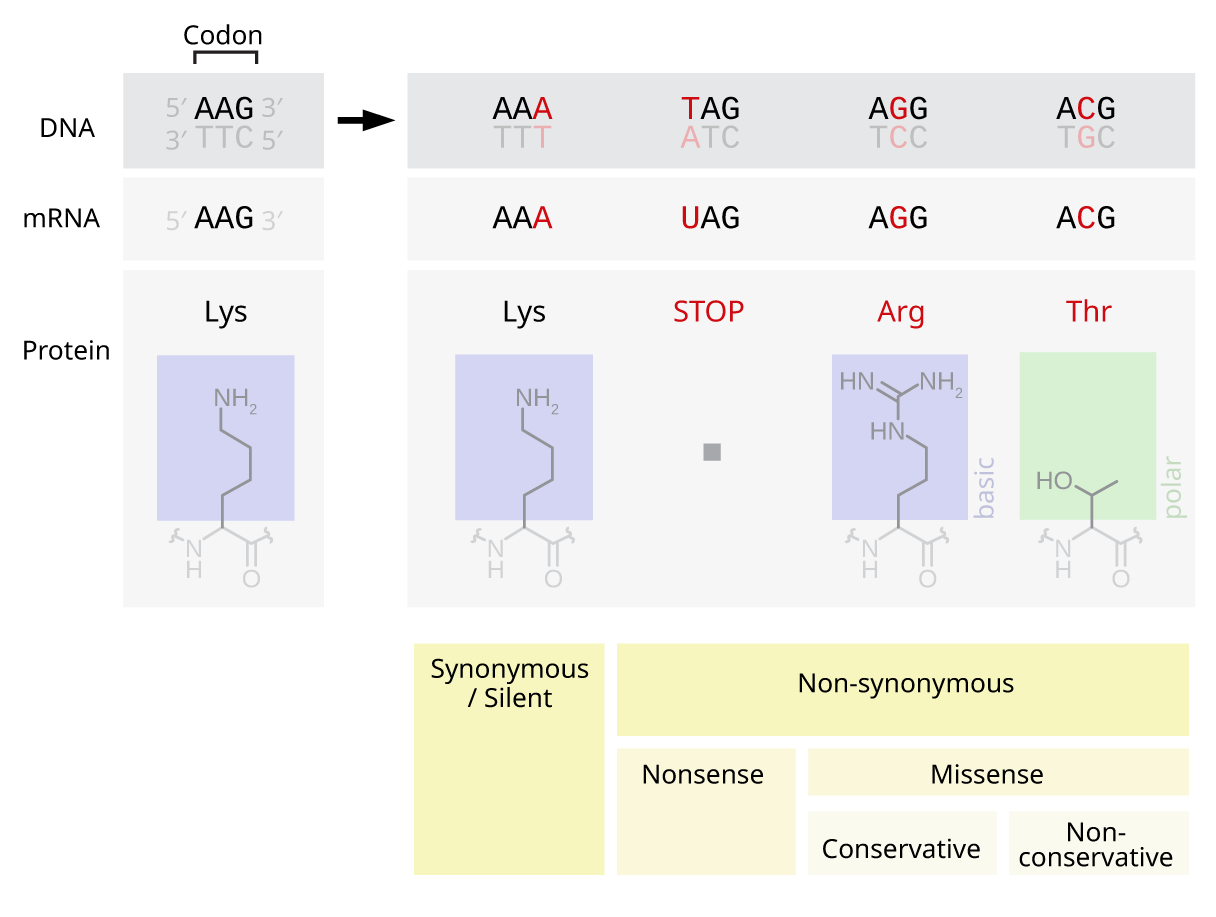
     This unit focused on four main concepts: DNA replication, protein synthesis, mutations, and gene expression/regulation. DNA has to be replicated identically because all cells have the same DNA. It has to unzip and fill in the bases missing in the base pairs. This is done by the DNA Polymerase, and now there are two identical strands of DNA. Protein synthesis is the process of making a protein. RNA is heavily involved in this process. The synthesis starts with transcription. DNA is unzipped again and this time, the RNA Polymerase copies the gene to mRNA (messengerRNA). Thymine is replaced with uracil, and after this is over, the mRNA goes to a ribosome. Now, translation can begin. The ribosome, or rRNA, reads the mRNA three bases at a time. These three bases are called a codon. One codon translates to one amino acid, and the animo acids formed are chained together by the ribosome. The chain folds and becomes a protein. This whole process can also be referred to as "walking the dogma". Mutations can be harmful or helpful to organisms and there are different types. Point mutations only affect one or two bases at a time. Substitution switches one base for another. Framshift mutations, like insertion and deletion, can add or subtract one or two bases in a sequence. Also, inversion and translocation involves DNA or chromosomes breaking and bonding with itself or other chromosomes. Finally, gene expression is the process of DNA being used to produce a phenotype. Gene expression has to be regulated, otherwise, ears would grow from your stomach, or eyes could grow on the top of your head. In prokaryotes, a operon, with a promoter, operator, and other parts, is used to regulate the expression of genes. Eukaryotic regulation uses proteins (called transcription factors) to control transcription. After that, the DNA is separated into exons, used DNA, and introns, unused DNA. DNA can wrap around proteins called histones to form nucleosomes.


     My strengths were completing the vodcasts on time and basically understanding the concepts by the time I got to class. During class, I was able to completely understand the concepts with Do Nows, recapping the vodcast, and labs. I think that I can do better on labs and not make mistakes I can avoid. During the DNA extraction lab, for example, I was not able to extract DNA, probably because of an error I had made during the process. Also, I should do my textbook notes early and not procrastinate on them until the last minute.
     I am a better student than I was before because I have gotten better at managing the class over time. I can now follow along with the vodcast and pause less often. It is now easier for me to write Relate and Reviews, and I realize that they help a lot, especially now studying for the final. I believe that I am a good student because I do my work, understand the concepts taught to me, and be efficient and thorough with my work. I took the VARK questionnaire, and it said that I have a multimodal learning preference, and I wasn't sure what to do with that result. In conclusion, I am getting through the class, but I can always get better than I am now.

Tuesday, December 13, 2016

Protein Synthesis Lab

     The process of making a protein has two main steps. DNA is replicated by an enzyme, but the copy is RNA, specifically called mRNA. The mRNA is different from the DNA because it contains uracil (U) instead of thymine (T). The mRNA then leaves the nucleus to get to a ribosome. At the ribosome, the mRNA is translated into amino acids (which make up proteins) by separating three bases at a times. One three base combination is called a codon, and each codon creates a specific amino acid. As they are made, the amino acids are chained together to make a protein.


     All mutations can have an effect on a gene, but some specific mutations can make a big difference in the DNA sequence. Deletion or insertion (both frameshift mutations) at the beginning of a sequence seem to affect the whole sequence the most because it changes all of the amino acids after it. Also, it can even cause the translating not to start at all. The mutation that has the least effect was substitution because it only changes one amino acid out of the whole chain. 


     I chose deletion for my own mutation because I thought that it would cause the most change (damage) to the chain of amino acids. It changed many of the amino acids after it. By placing this mutation at the beginning of the sequence, it changed all the amino acids as a result. Because of this change in all of the amino acids, the protein would probably not do what it is supposed to do, and it wouldn't function correctly.

     Progeria causes accelerated aging. It is caused by a mutation in the LMNA gene, a protein which provides support to the nucleus of a cell. Most people who have progeria die by the age of 13, due to age-related health problems. Progeria interests scientists who are trying to connect certain genes with aging.

(LMNA Gene)


Monday, December 5, 2016

Human DNA Extraction Lab

     In this lab, we asked the question, "Can DNA be separated from cheek cells, and if so at what point do you predict you will be able to see the DNA?". We found that you could, if you follow the process correctly, after a process called lysis and during precipitation. I was not able to extract DNA possibly because of an error during the experiment, but others did extract their own DNA. The DNA came out as a precipitate into a layer of cold alcohol. This occurred because the alcohol is nonpolar and the DNA is polar. This data supports my claim because this occurs after lysis, during precipitation. Lysis is the disintegration of a cell by rupture of the cell membrane.
     Our data contradicts the expected results because DNA was not extracted. This could have been because while the isopropanol alcohol was poured into the solution too quickly and not from the right angle. Also, during the stage of homogenization (preparation of a suspension of cell constituents from tissue by physical treatment by a liquid, the liquid being Gatorade), too much Gatorade or detergent (used for lysis) could have been measured in too large or small quantities, which could have changed the process or made it not work. One recommendation that I have is to measure quantities carefully and accurately. Another is that all actions done in the lab, like pouring alcohol, should be done in the proper way.
     This lab was done to demonstrate how DNA is extracted and when you extract it. From this lab, I learned about homogenization, lysis, and precipitation, which helps me understand the concept of DNA extraction and the structure of DNA. Based on my experience in this lab, if my or someone else's DNA is needed in a situation, I understand how to extract it from human cells.

Monday, November 28, 2016

Unit 4 Reflection

     In this lab, we flipped coins to simulate sex, which of course leads to the offspring obtaining traits. Each side of the coin represented one possible allele (for the genotype using two genes). We tested and compared different experiments (including mono- and dihybrid punnett squares that made predictions about the offspring's traits) and saw if the results matched our predictions. Some of the traits were autosomal and some were X-linked. The coins and the flipping represents segregation and independent assortment because of their randomness. The results of the dihybrid cross didn't match with the prediction because most of the resulting genotypes were heterozygous dominant, while there were no homozygous recessive genotypes. We predicted that there would be three phenotypes of blonde hair with brown eyes, but there were only two of them. Probability can be predicted, but it isn't always accurate. The results predicted by the punnett square cannot be and aren't correct at all times. This understanding can be used in the event that I have a child, and its traits can be predicted using genetic tests and punnett squares.

     The overall theme of the entire unit was genetics. The main ideas of the unit started with the cell cycle, or mitosis. Then, we were introduced to meiosis and were able to compare and contrast between the two. Later, we learned about what happens before sex, and we re-learned the basics of traditional dominance discovered by the scientist Gregor Mendel. In addition, asexual and sexual reproduction were compared and contrasted, and the laws of  segregation and independent assortment were taught to us. There are many exceptions to the traditional expections of genetics, including incomplete dominance, codominance, and polygenic traits. Lastly, we learned about how probability ties together with punnett squares and how punnett squares are drawn and used.
     My strengths were re-learning the basics of the genetics discovered by Gregor Mendel and the process of meiosis. I was able to understand the major concepts and main ideas of this unit. One weakness I have is applying my knowledge of genotypes and punnett squares (with monohybrid and dihybrid crosses) to questions about the inheritance of traits. Sometimes, it gets confusing to put together all the possible genotypes and draw the punnett square to predict the probability of a trait. I was able to manage the class by completing all of my vodcasts and other homework on time. I now have more knowledge about genetics and how to apply it to certain situations. By doing the infographic, I learned that writing words on paper isn't the only way to keep and remember information. The use of pictures and graphics helps to make certain concepts easier to understnad and apply. Infogrpahics are a good way to learn in general and are interesting to study. I am a better student now because I know more and can do vodcasts and labs better because of more practice. In the future, I would like to learn more about the exceptions of genetics and how exactly they work and create so much genetic variation in the world.

INFOGRAPHIC