Monday, May 22, 2017

Calabaza Creek Clean-up

On Sunday, May 20. I went to the Calabaza Creek in Cupertino. Then, for three hours, other volunteers and I cleaned up the creek. We used gloves and trash picker-uppers to pick up plastic and other pieces of trash at the river. We means groups because we had to work in pairs. Because there was not very much water, we were able to walk around the rocks and dirt to look for trash. The most common trash were cigarette butts. wrappers, and small pieces of paper or plastic. At the beginning, it was easier to find trash. After that, it took some time to look for each piece of plastic in the dirt and brush. We had to dig around and use good observational skills to find small pieces of plastic. These are the parts that fish can eat and get sick from. That is why it is important to find and pick up these as well as large boxes or bags. From this experience, I gained more knowledge about what trash is our rivers and how much of it there is. I learned how fish can get affected by eating plastic that we leave behind. I helped the community of Cupertino and other communities like it, and that is a good feeling to have. I gained experience on how to use my time. Since we had three hours, I had to plan out how to use my time and when to take breaks. I took away with me a sense that I had done something important and worthwhile. These kind of events can also raise awareness about the wasteful actions that people do all the time, such as littering, which can cause trash to get into rivers. I could do this again if I had the chance to. There is another clean-up in September, so it is possible that I could. One thing that I know now is that we take advantage of the nature around us. We need to protect it in order to continue to live and survive on this planet.


20 Time Individual Reflection

     My 20 time project was an experiment that was trying to find which food they preferred: genetically modified food or organic food. People rated the food on a scale of one to five on appearance and taste. The three foods we used were cheese, corn, and bananas. We also included some research that we did about the topic. I chose this project because at the time of choosing, we had learned about biotechnology and the modification of food. It seemed like an interesting topic to learn about and test. My partner and I did this project to inform people about the two different kinds of food. It was also done to see if there actually was a difference in preference among people. People can make their own decision about what they want to eat, but now they will have more information about each.
     Our initial plan was to do research for a few weeks and then conduct our experiment. Our first weeks were well-spent, and we looked at and got sources for our information. The original plan was to use about ten people as test subjects. That number went down to about seven. In the end, we ended up testing four people for each of the three foods. One thing that I would have done differently if we had more time would be to get more people to do the test. Then, we would have more generalized data at the end. Still, our experiment provides a small sample of what people prefer. Our experiment also could have happened earlier in the year. We were not getting the materials in time to conduct the experiment on the dates we set. This could have allowed us to involve more people. A success was that we finished the project. We explained the experiment, put together data tables, analyzed our results, and included some of the research we had done at the beginning. We put it all together in a document and included a works cited.
     If I did this experiment again, I would stick to our deadlines and get more test subjects. I got better at doing experiments because we had to put together our own instead of it being given to us. My researching also improved because we had to find reliable sources for our information. Since I worked with a partner, I made my communication skills better. We did not always agree on what was best for the experiment, but we compromised and ended up finishing. We were able to work together to complete work and reach a common goal. I learned that I could get things done (while not always meeting deadlines) when I put my mind to it. I need to procrastinate less if I want to get things done on time and done well. I am done with this challenge now because we completed our project. We collected our data and analyzed it. There is still more to learn about this topic, but this experiment can give people more information about what they eat. It's not too much information, but it will include things that people have never seen before.

Thursday, May 11, 2017

Unit 9 Reflection

     In this unit, we learned about the seven taxonomic levels and how life is classified into these levels. The seven levels are kingdom, phylum, class, order, family, genus, species. An addition is the three domains, Eukarya, Bacteria, and Archaea. Bacteria can be gram-positive or gram-negative, which means they either have less or more peptidoglycan in their cell walls. The different kinds of bacteria include cyanobacteria, symbiotic bacteria, and actinomycetes. Archaea live in extreme environments including anoxic mud, hydrothermal springs and digestive tracts. They challenge what we think is required for living. In the domain Eukarya, there are the kingdoms Fungi, Plantae, and Protista. Protista are very diverse and can be plant or animal-like. Fungi have cell walls made of chitin, absorb food through hyphae, and have fruiting bodies and spores, They include club and sac fungi and bread molds. Plantae (plants) have pollen, seeds, vascular systems, cuticles, and fruit. Bryophyta are seedless non-vascular mosses. Pterophyta are vascular seedless ferns. Gymnosperms have seeds in cones, and angiosperms have seeds in fruit. Throughout the different levels so far, there has been continual change between each kingdom. Each organism evolved to become a more recent one. This continues in the kingdom Animalia.

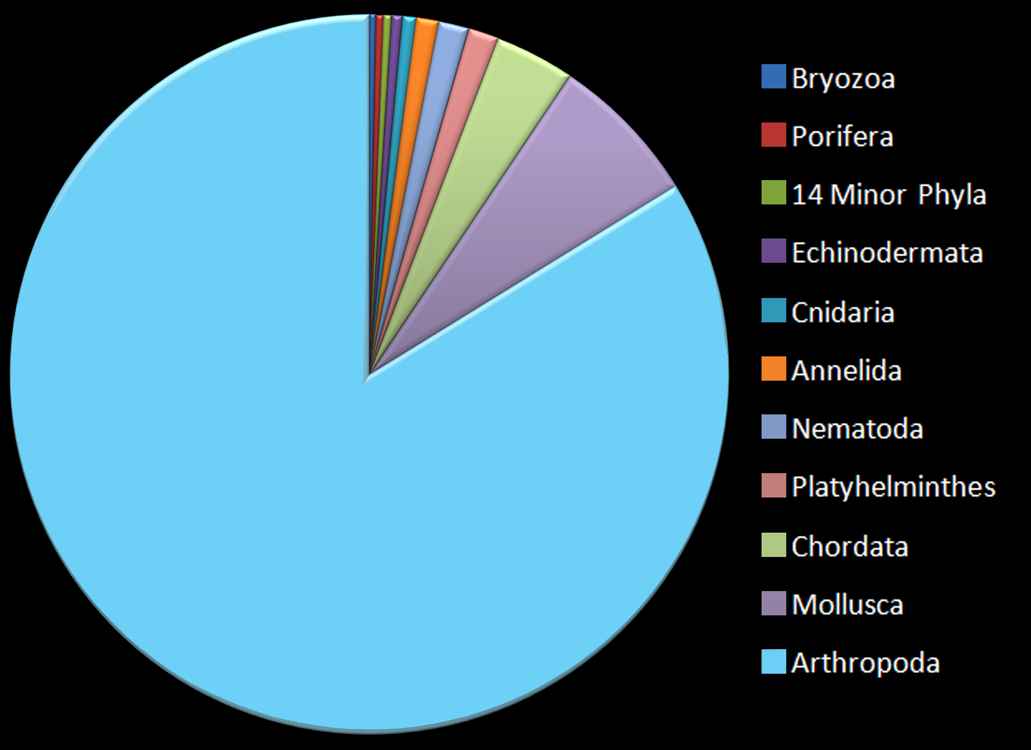
     In the kingdom Animalia, there are phyla of invertebrates and vertebrates. The first invertebrate phylum is Porifera, or the sessile filter-feeders, otherwise known as sponges. Another phylum is the Cnidarians, who are the first vertebrates to have specialized tissue. They include coral, hydras, and jellyfish. The next three phlya are closely related. Platyhelminthes are flatworms with an incomplete or no gut. The three classes are planarians, flukes, and tapeworms. Molluska have a digestive system, and they are snails, slugs, clams, and squids. Finally, Annelida are segmented worms with a coelom, like earthworms. A huge phylum is Arthopoda. The two classes in it are Insecta and Crustacea. The last phylum of invertebrates is Echinodermata, who have a water vascular system with a skeleton made of interlocking ossicles. The five classes include sea stars, sand dollars, basket stars, sea cucumbers, and sea lilies. Then comes the phylum of all vertebrates, Chordata. It starts with fish, specifically the jawless fish of class Agnatha. There are two other classes of fish. Condricthyes have a skeleton made of cartilage, and Osteicthyes have a bony skeleton. After the tranistional forms of fish climbed up onto land, the amiphibians (Amphibia) came into being. They include the salamanders, caecilians, and the frogs/toads. Reptilia is the class with the crocodilians, snakes, lizards, and turtles. They are ectotherms with a three-chambered heart and a cloaca. Aves (birds) evolved from therapod dinosaurs, and they have wings, feathers, and re-arranged hip muscles. The last and most recent class is the class Mammalia. Mammals are complex, social organisms with hair, a chewing jaw, and a four-chambered heart. The three gruops are marsupials, monotremes, and eutherians, or the most recent mammals. In each ensuing phylum and class, there is more diversity and more helpful traits that all lead to the existence of humans. As life went on, speciation and evolution occurred to create the organisms that exist today.
                                                                                                                                                                                      https://upload.wikimedia.org/wikipedia/commons/3/3b/AnimalsRelativeNumb ers.png 


     I wonder about what species we still have to discover and how we will classify them. There are so many species in the world that humans have not discovered yet. New phlya and classes could be created to accommodate a new, diverse species. Also, all of these organisms lived during different time periods, and we did a project showing a timeline of Earth's history. Click here to see my reflection on the project. In this unit, we also did presentations about different organisms to show exactly what on Earth evolved. My presentation went well and I was able to be in the time limit range. I believe that this is because I was well prepared, I practiced beforehand for my presentation, so I didn't read from my slides as much. One thing I could have improved on was putting less information onto the slides and not relying on it so much. By that, I mean that I could have spoke more from my own memory and not crowd the slides with information. I could have used it more as an aid than as the basis for my speaking. This gave me valuable experience with public speaking, as I will certainly have to do more of it in my life. I practiced speaking in front of an audience, and I got to see other people do it too. I learned a lot about other organisms on Earth, and each one was taught be a different person. Below is my presentation about the Australopithecus, the first ever upright-walking hominid.
    

Thursday, April 20, 2017

Geologic Timeline Reflection

     One major event is the mass extinction at the end of the Cretaceous period of the Mesozoic era. This event led to the rise of mammals, and that is why we are alive today. Without the dinosaurs ever going extinct, the dinosaurs might still be here on this planet. The history of the Earth in its later stages would be drastically changed and would not not be the same at all. Most of the mammals on Earth could be killed by dinosaurs. Another important event was when Pangaea formed in the Carboniferous period. If Pangaea never formed, the continents would not be like they are today. It's possible that the continents could have still been formed but they would not be the same. A third important event is the when Archaeopteris, the first successful trees, in the Devonian period came into being. If trees never existed, we would be be alive and the Earth would definitely be different and other organisms would be on Earth. Only organisms who don't need oxygen would survive. If any of these events never happened, the Earth would not be as it is today. 

     The longest era is the Precambrian, and it took up most of the time in the history of Earth. The Cenozoic era only just started and yet humans have had a large impact on the world. I was surprised when I found out that humans only take up a very short time in the span of everything since the Earth has formed. I thought that humans were on this planet for longer than they actually are. I think that I just didn't realized how long Earth has been in existence. I also did not really know about the Paleozoic era, and that is the era that I researched. Some important things happened in this era, like the diversification of vascular plants and the colonization of land by fungi, plants, and animals.

     Humans have had a large impact on the Earth. The good things that we have done have been to help ourselves to survive and reproduce on this planet. However, we have also had a bad impact on Earth. We are using its resources without knowing what it is doing to Earth. Also, some scientists have evidence that shows what we are doing, like using up the oil on Earth and releasing carbon dioxide in the atmosphere, is harming our planet. Some people are listening and are raising awareness, but not enough. A question that I have is, "Will we do anything to slow this mass extinction we are currently in?" Many people don't know about what is happening on the Earth now. There is climate change and ocean acidification and many other events happening. People are smart enough to come up solutions to the problems that we are facing, but enough minds are not on the problems. I do not have any more questions, but I wonder whether we as humans and as organisms on this planet will try to do something to help the planet, not only ourselves.


Monday, April 10, 2017

Unit 8 Reflection

This unit was called Constant Change, and it focused on evolution. It was about what causes evolution and what effect evolution has on populations. Natural selection is the driving force behind evolution, and populations, not individuals, evolve. Humans have come up with artificial selection. They decide what trait they want to see in an animal, mate two individuals with the desired trait, and see what they end up with. In other words, they are effectively breeding for a trait, and sometimes, the resulting individual will be different enough from its parents that it is considered a new breed. This selection is therefore not natural, and the end product is created because of the preference of a breeder. Evolution is defined as changes in allele frequency over time. Allele frequencies is the percentages of different alleles in populations. Natural selection is when traits that help organisms survive and reproduce continue into the populations that come after, while the unhelpful traits decrease in frequency and can eventually disappear. In other words, the population starts to look like the winners, while the losers' traits go away from the population.


Natural selection was demonstrated in the Bird Beak Lab and the Hunger Games Lab because different traits were tested for their ability to help organisms survive and reproduce. There is also evidence of evolution that has been found today. There is the usual, fossils, and they physically show the change in populations over time. Also, they can be dated to see how old they are. Embryology, the study of embryos and their development, and evo-devo, comparing the developmental processes of different organisms, are also new ways that scientists have found to prove common ancestry and evolution. Homologous structures, similar bones with different functions, and analogous structures, different bones with similar functions, show that individuals have a common ancestor. Different organisms having analogous structures has occurred because of convergent evolution. This happens when two unrelated organisms develop similar traits because they have to adapt to similar environments or ecological niches.


A geologic timeline can show how life on Earth has changed over time. Earth was formed about 4.6 billion years ago. The time since has been divided into eras, periods, and epochs. There have been five mass extinctions, and we are now in the midst of a sixth. The four eras are the Precambrian, Paleozoic, Mesozoic, and Cenozoic. Then, the eras are split into periods. Life appeared in the first era, then the Cambrian Explosion. After that, it was the Age of Reptiles, and finally, us humans came into being. Earth has changed rapidly throughout its history, and humans have just arrived onto the scene. We are still making a big impact on the Earth itself. New species occur through speciation, which is caused by reproductive isolation. It can be behavioral, temporal, or geographical. Populations evolve through three different kinds of selection. Disruptive favors the extreme phenotypes, stabilizing favors the intermediate, and directional favors either one of the extreme phenotypes. Evolution continues to happen today, and it is important to learn about it because this knowledge can help us to deal with change when it happens in our world.

 
 I want to learn more about the evidence that we have of evolution. It would be interesting to physically see fossils that show the changes over time, and see evolution that has taken place in past generations. This could be with analogous or homologous structures. I do not have any unanswered questions. I wonder about what will happen to our species. We have been on this planet for so little time, yet we have made so much change to this planet. I wonder if we will change what we are doing to try and help the planet instead of harming it. Everyone should become aware of what is going on in the world. I also wonder how our species will continue to evolve over time and if natural selection will play a role in our survival. Relating to assertiveness, I am mostly able to say what I want and speak about myself. I can probably become more clear with my priorities when I am doing something with other people. I can still continue to become more assertive while also listening to what others have to say, rather than dominating a conservation. That said, I should listen and contribute my own ideas that relate to what another person is saying. I can continue to become more confident in everything that I do and every situation.


Thursday, March 30, 2017

Hunger Games Lab

1) In this lab, we simulated natural selection by having different individuals with different traits compete to survive. The food was corks, and the variation was how we picked up the food. Stumpys, with the phenotype AA, picked up food between their wrists. Pinchers, with the phenotype aa, picked it up between their thumb and index finger. Knucklers, with the phenotype Aa, picked up food between the second knuckles of their index and middle fingers. An individual needed certain amounts of food to survive after each trial. Because of this, the populations kept changing.
2) The knucklers were the best at capturing food, and this is shown because their populations were mostly the highest. The individuals with this trait were able to pick up more food between their knuckles and could quickly collect and store the food.
3) The population did evolve because the allele frequencies of A and a kept changing throughout the lab. The frequency of the A allele changed from 0.50 at the first trial to 0.38 at the last. The a allele's frequency changed from 0.50 to 0.62. Evolution is changes in allele frequency over time, so evolution occurred.
4) The placement of the food was random and was an example of genetic drift. Depending on who was nearest to the food, they were able to collect the most food. Also, people cheating, not conforming to the trait that they were supposed to have, was random. Different people did this throughout the trials, and that affected the results. What was not random was the starting populations, when each trait had an equal population size. Also, the type of food and and the traits that individuals had weren't random.
5) If the food were bigger, it would probably be harder for knucklers to pick it up between their knuckles and the pinchers would have an advantage, and the stumpys could also. If the food were smaller, the stumpys could have a hard time picking it up, while the pinchers and knucklers could pick up more food at once.
6) If there was not incomplete dominance, then the intermediate species would have a different trait, and it would not be knucklers. This would affect allele frequency because these individuals would probably have more, or less, success than that of the knucklers.
7) Natural selection is the driving force behind evolution. Changes occur in a population naturally because of the enivroment or ecosystem an organism is in. Some species will have an advantage, while others will not. The frequency of the helpful trait will increase, while the other will decrease.
8) Some people tried to put much food as they could into their pockets and that way, they were able to store and collect more food than others. Also, people did cheat, and that helped them survive until the next trial. Some individuals probably would have died if they had completely followed the rules. Overall, these factors just helped more people survive, with the knucklers maintaining the highest population.
9) In evolution, populations, not individuals, evolve. When an organism is born, they are stuck with the genes their parents gave them. Only when they reproduce does the population evolve, because of a change in allele frequency. Natural selection acts on phenotypes, not genotypes. Depending on the traits an organism has, natural selection, based on whether the traits are helpful or not, either makes the population have that trait or decrease in individuals with that trait.
10) How would the addition of another trait affect the population's evolution?


Wednesday, March 8, 2017

Unit 7 Reflection

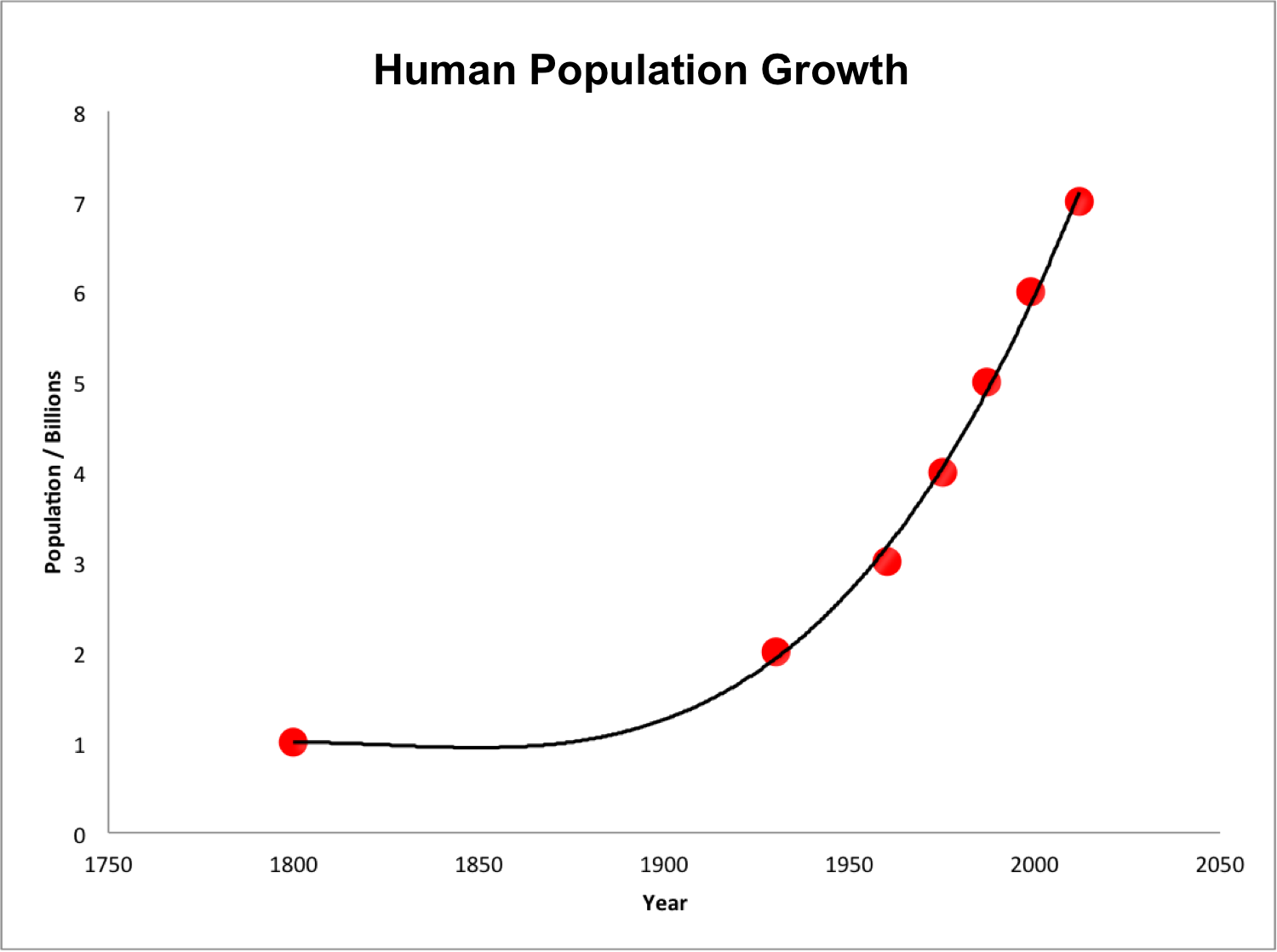
     This unit was about ecology and conservation biology. Ecology is the study of interactions between different organisms and their environment. Some big ideas of ecology are homeostasis and interdependence. The levels of organization of ecology are organisms, population, communities, ecosystems, biomes (an area of the world that contains many ecosystems), and the biosphere (Earth). We also learned about food chains and webs, and the differences between them. If one organism declines in an ecosystem, then, a domino effect is sent throughout the food web, and other populations could decrease. Next, we learned about the energy in ecosystems, which can be shown through biomass pyramids, pyramids of numbers, and energy pyramids. Only 10% of the energy at one trophic level (primary producers, primary consumers, secondary consumers, tertiary consumers, and quaternary consumers) is passed to the level, so there is less energy to go around as you go up the energy pyramid. That is why it is important to have many primary producers who transfer all of the energy to the next levels. Another part of ecology is population ecology, the study of populations in relation to the environment. Many different factors, like deaths or immigration, affect the rise and decrease of populations. Exponential growth is the doubling of a population over time. Logistic growth is when the rate of growth slows down as the carrying capacity is reached. A carrying capacity is the maximum point at which an environment support a population. The human population has been exponentially growing for some time now, and after more time, it is expected that it will reach its carrying capacity. At carrying capacity, the population will decline and rise again or level off (number of births will equal the amount of deaths).


     There are also different cycles that help to keep an ecosystem healthy. Ecological succession occurs with a sequence of community and ecosystem changes after a disturbance (ex. fire in Yellowstone causes the ecosystem to grow). Primary succession is when everything in a ecosystem has been harmed/disturbed, while secondary succession happens when part of an area is still intact. The water cycle includes evaporation and precipitation, while the carbon cycle involves cellular respiration. The nitrogen cycle can be the conversion of nitrogen gas into nitrates for plants or the breaking down of nitrogen from waste (into nitrates) from waste or dead organisms. Phosphorous makes up ATP, DNA, and lipids, and it is deposited by water and made available to plants. Decomposers and producers are critical to life. High biodiversity is important for ecosystems to be considered healthy because organisms are resistant to changes. Populations with producers & decomposers/tertiary & quaternery concumers are features of a healthy ecosystem. Four causes of species loss are climate change, overexploitation (harvesting organisms too fast/much so populations cannot rebound), introduced/exotic species, and habitat loss. There are five ways to conserve/protect ecosystems: identify and protect (biodiversity) hot spots, conservation (protect what we still have), smart planning (some solutions to help ecosystems (ex. movement corridors)), restoration (ex. jumpstart succession), and sustainable development (development that meets the needs of people today without limiting the ability of future generations). Finally, there are small things that each person can do to help, and if everyone does something small, there will be a big effect.


     I want to learn more about the different ways people are trying to conserve ecosystems through sustainable development or smart planning. The movement corridor and green roof are interesting ideas. I do not have any unanswered questions. I wonder about how people can raise awareness for the enviromental issues the earth is facing. Also, I wonder how we can all consume less and not run of resources. The Conservation Biologist project was a good project because I got to learn more about a place in the U.S. (the Great Plains) and the threats facing it. I thought my group worked well together, and everyone took part and did their work. Also, I got to practice explaining about a topic (in the video) besides just listening, and when you explain something to someone else, you learn it better yourself. I felt that our group could have recorded our video earlier because we went one day extra on our schedule to finish the presentation. Overall, our group did a good job on the project and created a educational video. My dominant conflict style is aggressiveness, with assertiveness the second, then passiveness, then finally passive-aggressiveness. I feel that in some situations, I could be aggressive or passive. I don't ask for help a lot, so that can improve my assertiveness. I don't think I am passive-aggressive often, but sometimes I can be. I think that whether I am aggressive or passive depends on where I am or who I am with, but I should try to be assertive most of the time. I could voice my ideas more, think about what I say before I say it, and say what I think is the right thing to do.